 dailyupdate4u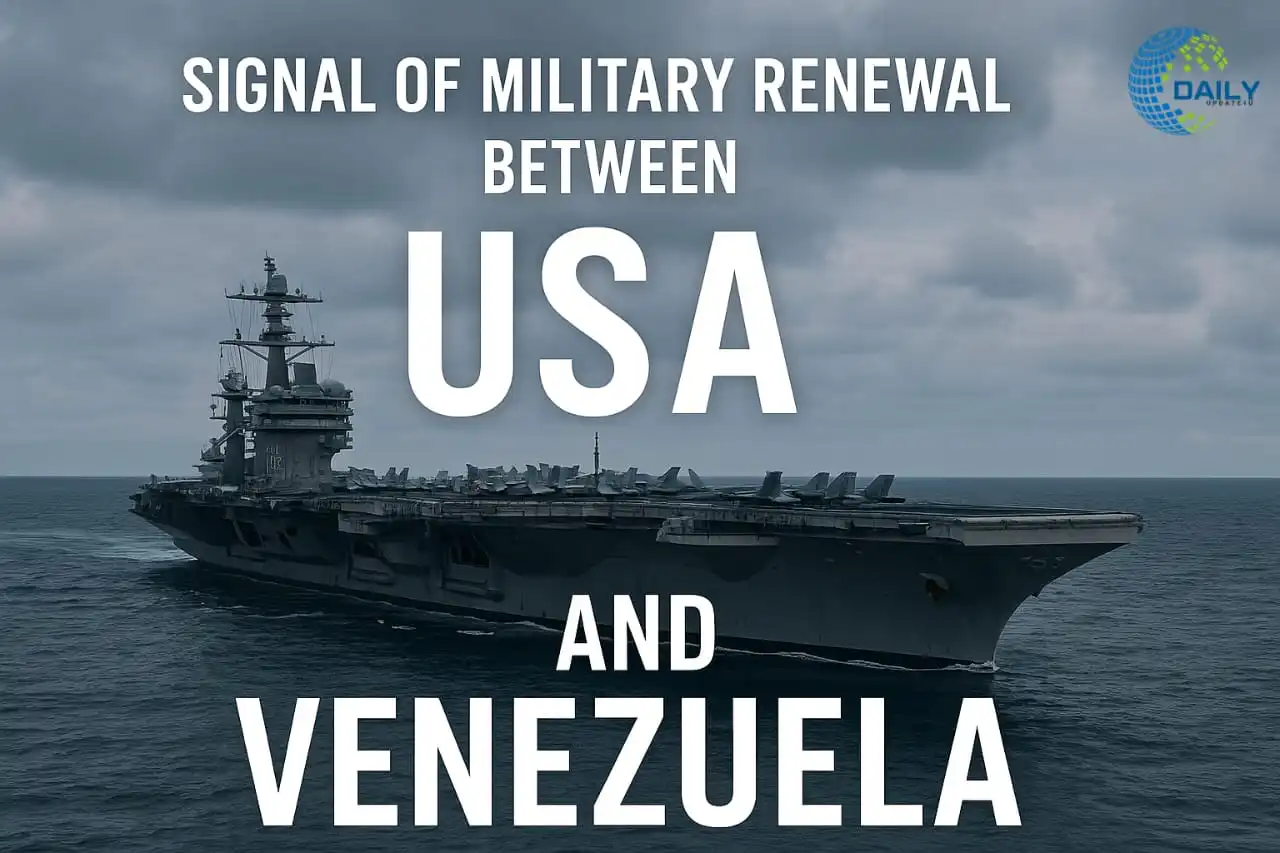
The US-Venezuela relationship has always been a topic of discussion in international politics. While the US is known for its global military power, security policy, and geopolitical influence, it is also one of the major powers in South America that has long openly opposed US policies. From former Venezuelan President Hugo Chávez to the current leadership, tensions, accusations, economic sanctions, electoral disputes, and oil politics between the two countries have consistently dominated the headlines.
Recently, news broke that the US aircraft carrier USS Gerald R. Ford was approaching Venezuelan waters, suddenly capturing global attention. This move is being seen as not just a routine military activity but a signal with significant and far-reaching implications on many levels.
Is the US really increasing pressure on Venezuela? Is this an operation against drug trafficking, as the official statement claims? Or are there broader geopolitical objectives behind it?
This blog post provides a detailed analysis of these questions, allowing readers to understand the entire scenario in depth.
➡️ How did relations between the US and Venezuela deteriorate?
✅ The Cold War Era and the Clash of Ideologies
Ideologies had a profound impact on the relationship between the US and Venezuela. For decades, Venezuela took a stance against socialism, government control, and US intervention. During the Cold War, the US pursued a policy of preventing the spread of communism in Latin America. As such, the US expected cooperation from nations like Venezuela.
But over time, politics took a turn.
✅ Hugo Chávez: America’s Biggest Critic
Hugo Chávez, who came to power in 1999, was known for his anti-US statements, policies, and alliances.
He stated, “America is a symbol of global imperialism, and we will not bow to it.”
✅ During this period,
Venezuela drew closer to countries like Russia, China, and Iran.
The United States began reducing Venezuela’s dependence on oil imports.
Diplomatic tensions between the two countries escalated.
✅ Nicolas Maduro: A New Chapter in Tensions
After Chavez’s death, Nicolas Maduro became president, and tensions escalated further.
The United States leveled several allegations against the Maduro regime:
Election rigging
Human rights violations
Complicity in drug trafficking
Suppression of democracy
In response, Venezuela accused the United States of “regime change through conspiracy, media warfare, and economic sanctions.”
➡️ What is military freshness? Why is the deployment of the USS Gerald R. Ford considered significant?
✅ USS Gerald R. Ford — The World’s Most Powerful Aircraft Carrier
This US Navy ship is a symbol of a superpower. It has
State-of-the-art weapon systems
Over 75 fighter aircraft
Advanced radar, electronic warfare capabilities
High speed and a spacious flight deck
Capable of military operations, surveillance, power projection, and emergency response
Its presence in any region of the world is a powerful message in itself.
2.2 What does its approach to Venezuela indicate?
It indicates that:
The US is increasing its military presence in the region
Attempts are being made to pressure the Venezuelan government
US power projection has intensified amid elections or political turmoil
Interference is increasing based on drug trafficking, maritime security, and political instability
✅ Official Arguments Versus the Actual Message
US officials stated that this operation was part of a “counter-narcotics mission.”
But analysts say that
The deployment of the world’s most expensive and powerful carrier isn’t just to stop drug trafficking.
It’s an indirect pressure on Venezuelan politics.
It’s also a response to the presence of China and Russia in the region.
It’s a show of strength in the name of protecting democratic values and human rights.
The Big Picture of Geopolitics
✅ The Declining US Influence in Latin America
Over the past 20 years, the region has witnessed the growing influence of countries like:
China
Russia
Turkey
Iran
This is a warning signal for the US.
Countries like Venezuela, Cuba, and Bolivia have openly distanced themselves from the US.
✅ Oil Politics: Venezuela, the country with the world’s largest oil reserves
Venezuela:
An influential member of OPEC
Owner of the world’s largest proven oil reserves
A hub for the massive oil trade
US energy politics have always been intertwined with Venezuela.
✅ Russia and China’s growing investment in Venezuela
Russia provides Venezuela with weapons and military equipment
China has invested billions of dollars in Venezuela
Both countries have openly challenged US sanctions.
Therefore, the US wants to stop the geopolitical cycle in which Latin America is slipping out of its grasp.
✅ US sanctions against Maduro and their impact
In recent years, the US has:
Ban on oil exports
Blocking banking transactions
Visa restrictions on leaders
Freezing Venezuelan assets
Taking drastic measures.
Their impact:
Venezuela’s economy weakened
Hyperinflation increased
Millions of citizens were forced to flee
But the regime remained unchanged, which poses a challenge for the US.
➡️ Venezuela’s Response and Domestic Politics
✅ Statement from the Maduro Government
Venezuela described the deployment of the US carrier as:
an attempt at provocation
imperialist interference
a threat to regional peace.
✅ Domestic Political Turmoil
On one hand, there is political tension surrounding the elections.
On the other hand, the economic crisis is so severe that the public is divided on the issue of US intervention.
Some believe:
The US is interfering
wants to seize their resources
While others believe:
US pressure is necessary
This will strengthen democracy
Will end corrupt rule
✅ Role of the Military and Opposition
The Venezuelan military is Maduro’s greatest strength.
The US knows that as long as the military is with Maduro, change is difficult.
The opposition, meanwhile, wants US support to pressure for the elections.
➡️ Impact on Regional Security
✅ Tensions Will Increase in the Caribbean
If US warships remain there for a long time:
Maritime tensions will increase
Merchant ships will be on alert
Neighboring countries will feel political pressure
✅ Reaction from Other Latin American Countries
Countries like Brazil, Colombia, Panama, and Argentina are politically divided:
Some are with the US
Some are with Venezuela
Some want to remain neutral
This division could affect regional stability.
➡️ What does this mean for India?
✅ Impact on the Oil Market
Venezuela has been a major source of oil for India.
If tensions escalate:
Oil prices may rise
Supply chains may be affected
India may have to explore new options
✅ Indian Investments and Workers
Many Indians work in Venezuela.
Instability could impact their security.
✅ Impact on Global Markets
Impact of US-Venezuela Politics:
Strengths/Weaknesses of the Dollar
Stock Market
Crude Oil Rates
Foreign Investment
which directly impacts India.
➡️ Is Military Confrontation Possible?
✅ The Probability of Direct War is Very Low
The US has known for two decades that limited military power, sanctions, and diplomacy are the best options.
✅ But the risk of minor skirmishes or naval tensions
Mutual encounters between military ships:
Warning Fire
Dispute over Maritime Space
Drone/Radar Lock
Conflict due to Misunderstanding
Could occur.
✅ Reactions from Russia and China could escalate tensions
If Russia or China sends its ships
The situation could become more complicated.
➡️ Future Prospects
✅ Opportunity for Dialogue
Both countries understand that military conflict would prove costly.
Therefore, diplomacy is the only way forward.
✅ Electoral Pressures
Electoral politics in the United States often influence foreign policy.
Venezuela is also grappling with elections and an economic crisis.
✅ Energy and Geostrategy
Both the United States and Venezuela know that oil is a major weapon in future politics.
➡️Conclusion
US-Venezuela relations are not just the story of two countries, but also:
Competition among global powers
Geopolitics of energy resources
Politics of democratic values and governance
Military power projection
And the strategies of developing countries
A broader picture.
The deployment of the USS Gerald R. Ford near Venezuela could open several new chapters in international politics in the coming months.
This can both increase tension and open the way to resolution.