 dailyupdate4u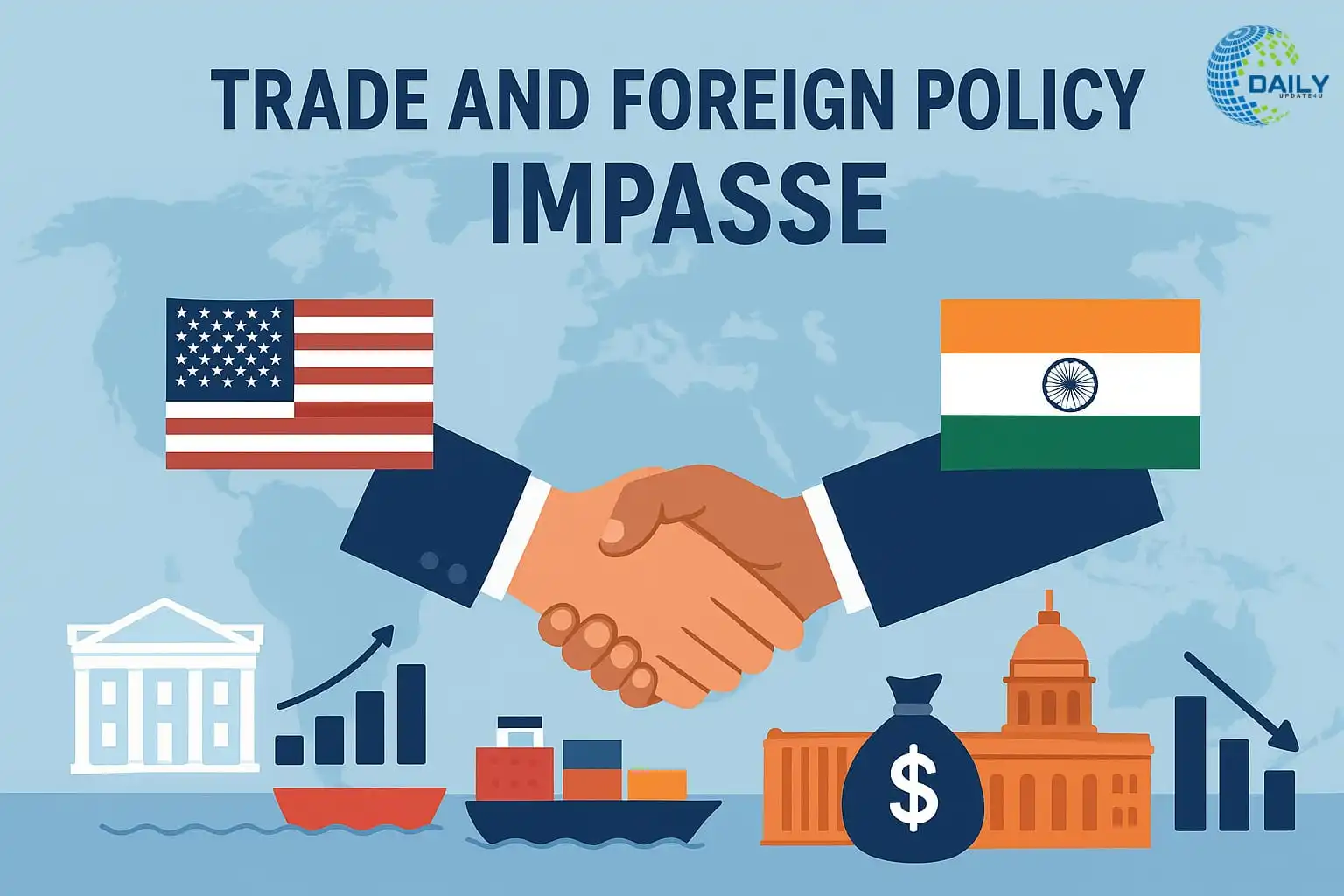
The United States and India are two democratic countries whose influence is felt not only within their own territories but also across the globe.
Over the past two decades, strategic, economic, and cultural ties between these two countries have steadily strengthened.
However, in recent years, especially after 2024, a new impasse has emerged in the areas of trade and foreign policy.
This impasse is not only the result of economic policies but also of changing geopolitical dynamics, China’s growing role, shifts in global supply chains, and domestic political pressures.
➡️Historical Perspective of US-India Relations
The foundation of US-India relations was laid since independence.
However, in the early decades, the foreign policies of the two countries took different paths.
India followed the path of the “Non-Aligned Movement,” while the United States remained the center of the Western alliance during the Cold War.
Since India adopted a policy of liberalization in the 1990s, trade and investment relations between the two countries have accelerated.
Cooperation has increased in sectors such as IT, defense, education, and health.
The 2005 civil nuclear deal established a new example of trust between the two countries.
But this relationship has not always been straightforward—at times, issues of tariffs, visa policy, defense procurement, and human rights have complicated it.
➡️ Key Steps to Strengthening Trade Relations
Annual trade between India and the United States currently exceeds $200 billion.
India is the United States’ ninth-largest trading partner, while the United States is India’s largest export market.
✅Key Trade Sectors
IT Services and Software
Medicines and Healthcare Products
Agricultural Products
Gems and Jewelry
Defense and Technical Equipment
Key Agreements:
2016: Logistics Exchange Memorandum of Agreement
2018: COMCASA Agreement
2020: Basic Exchange and Cooperation Agreement
These agreements enhanced military and technical cooperation between the two countries, but now some obstacles are emerging within this cooperation.
➡️ Key Reasons for Recent Differences
Since 2024, several factors have emerged that have increased tensions between the two countries:
✅ Trade Balance Issue
The US believes that India is overly dependent on US exports, while India says that US companies are monopolizing the Indian market.
✅ Tariffs and Duties
Indian exporters were affected by the US increasing import duties on some Indian goods.
India also imposed retaliatory tariffs on some US products.
✅ Technology and Data Control
The US wants India to relax its data localization policy, while India remains steadfast in protecting its citizens’ data.
✅ Defense and Weapons Purchases
India’s purchase of weapons from Russia makes the US uncomfortable.
The US wants India to be completely dependent on Western defense systems.
➡️ New Trump Administration Policies and Impact
After Donald Trump’s re-election in 2025, US foreign policy and trade approaches underwent a major shift.
The Trump administration imposed new tariffs and trade barriers to promote domestic industries under the “America First 2.0” policy.
This directly impacted all countries that export to the US, including India.
New restrictions were imposed on wood, furniture, pharmaceuticals, and software services.
India described this policy as “unilateral and protectionist.”
Many experts believe this will negatively impact the global trade system and increase instability in the relationship between the two countries.
➡️The China Factor and Indo-Pacific Policy
China is seen as a major challenge in America’s new foreign policy.
India is also embroiled in border disputes and economic competition with China.
Therefore, both countries share a common objective—limiting China’s influence.
However, under the Indo-Pacific strategy, the US expects India to be part of every military initiative,
while India wants to maintain its “strategic autonomy.”
This difference is at the heart of this policy.
India is active in the Quad (US, Japan, Australia, India), but does not want to be directly part of any military alliance.
➡️ Cooperation and Conflict in Technology and Defense
The United States has granted India the status of a “Major Defense Partner.”
Defense deals between the two countries have exceeded $25 billion.
But the United States is now leaning toward a more “control-based cooperation.”
India wants the United States to show flexibility in technology transfers so that Indian defense production can grow under the “Make in India” initiative.
However, the United States maintains a rigid stance regarding the security of its technology.
For this reason, many defense projects (such as those related to drones and fighter jets) are progressing slowly.
➡️ Economic Tariffs and Trade Barriers
In 2025, the US administration increased tariffs on wood, furniture, agricultural products, and pharmaceuticals under a new tariff policy.
India responded by imposing taxes on American steel, alcohol, and agricultural products.
Small businesses and consumers suffered the most from this “tariff war.”
Prices rose, exports declined, and investors became confused.
According to an IMF report, if this policy continues for a long time,
The GDP of both countries could decline by 0.5–0.8%.
➡️ Diplomatic Rhetoric and Media Influence
The US media has questioned some of India’s policies—such as the digital service tax, media freedom, and human rights issues.
The Indian media has criticized America’s protectionist policies and visa restrictions.
This mutual “narrative war” has also influenced public opinion.
The public in both countries is now viewing each other’s perspectives with suspicion,
which could pose a challenge to long-term relations.
➡️ Future Prospects
While differences exist, the two countries also have immense opportunities for cooperation.
Climate Change and Clean Energy
Digital Economy and Artificial Intelligence
Space Research
Defense Technology and Cybersecurity
If both countries move forward while balancing their respective interests,
This relationship can once again reach new heights.
India needs to maintain its “multi-polar diplomacy,”
while the United States should view India’s growth as an opportunity, not a competition.
➡️ Conclusion
The impasse seen today in US-India relations is temporary.
History shows that both countries have always overcome challenges through dialogue and cooperation.
In this new era of world politics, both countries have a shared responsibility
to maintain democratic values, global trade, and stability.
If both nations demonstrate flexibility while understanding each other’s policy limitations,
This “trade and foreign policy impasse” could transform into a new-age partnership in the years to come.