 dailyupdate4u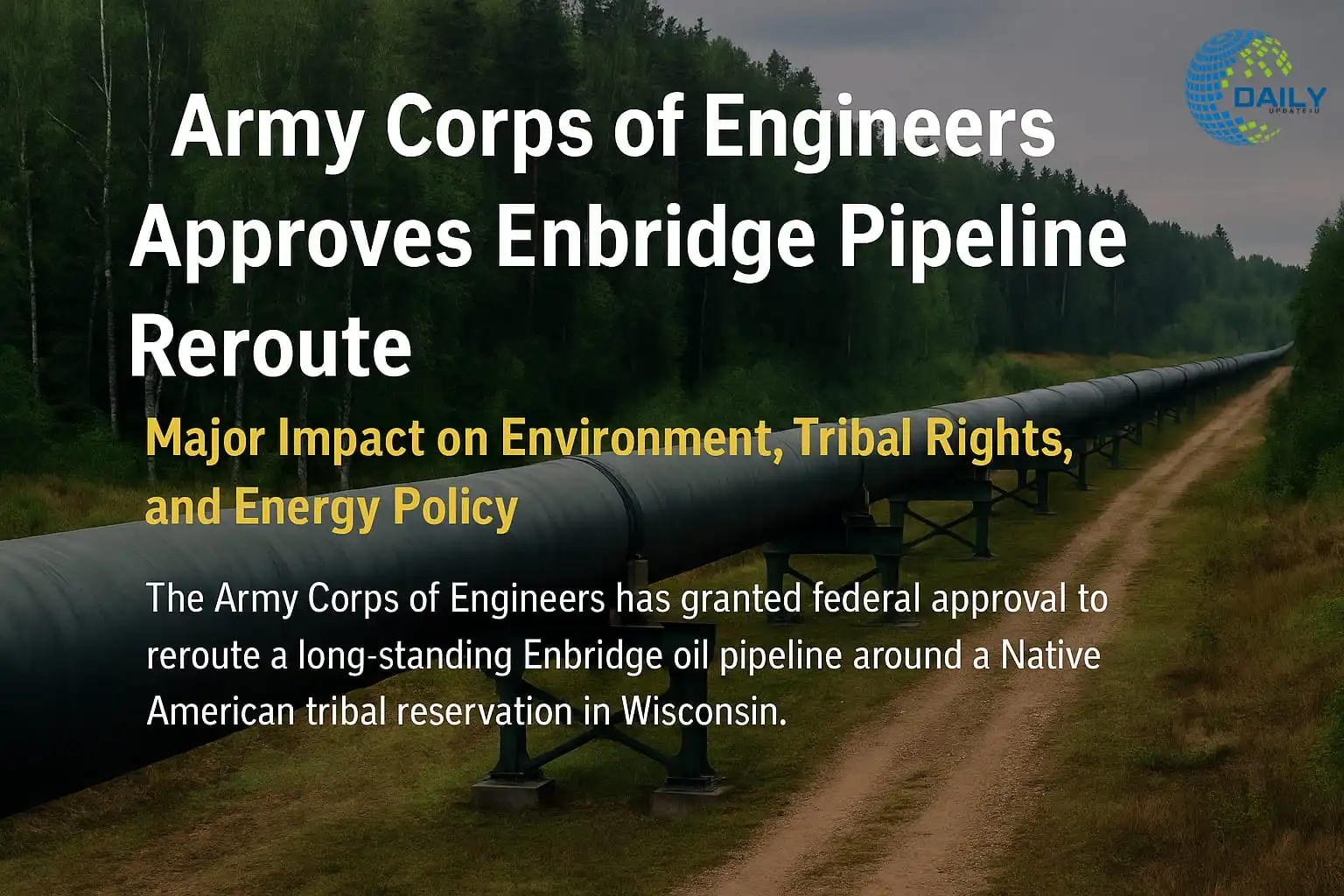
Energy policy, the environment, and tribal rights have once again come to a head in the United States. The U.S. Army Corps of Engineers recently approved the rerouting of Enbridge Energy Company’s controversial oil pipeline through a Native American tribal reservation in Wisconsin.
This decision opens a new chapter in a long-standing dispute—one that challenges balancing energy security, economic development, and environmental protection.
➡️ Details of the Decision
The approval is for a plan by Canadian energy major Enbridge Inc. to reroute its aging Line 5 pipeline.
The pipeline, established in 1953, transports crude oil and natural gas from Canada to the Midwest region of the United States.
The new route will be approximately 66 miles long, bypassing the reservation of the Bad River Band of Lake Superior Chippewa in Wisconsin.
The Army Corps of Engineers stated that the company had completed the necessary environmental studies and approved measures to protect water resources.
However, the Bad River Tribe and environmental organizations strongly opposed this decision.
➡️History of the Enbridge Pipeline
Enbridge Line 5 is one of North America’s oldest and most controversial pipelines.
Built in 1953, the line served as a major source of energy supply from Alberta, Canada, to Michigan and Wisconsin.
However, the pipeline has experienced numerous leaks and spills over the years.
In 2010, another Enbridge pipeline spilled nearly 1 million gallons of oil into Michigan’s Kalamazoo River.
Since then, environmental groups and tribal communities have questioned the company’s credibility.
➡️Role of the Army Corps of Engineers
The U.S. Army Corps of Engineers is the primary agency responsible for federal water resources and environmental permitting in the country.
Its role is to ensure that any major construction project does not harm water sources, ecosystems, and public safety.
✅For this project,
Enbridge submitted an Environmental Impact Assessment.
Public consultation and technical review followed for several months.
The Corps then issued a limited permit.
Nevertheless, tribal leaders say that “the federal agency did not fully respect tribal autonomy.”
➡️Wisconsin Reservation and Background of the Dispute
The Bad River Band of Lake Superior Chippewa Tribe is located in northern Wisconsin.
The tribe has relied on water sources from the Lake Superior Basin for centuries.
The older section of the pipeline ran directly through the reservation, leading the tribe to file a lawsuit in 2019.
The tribe alleged that Enbridge’s lease had expired and the company was illegally using the land.
The court ordered the company in 2023 to remove the pipeline by 2026.
Meanwhile, the company presented plans to develop a new route.
➡️ Reaction from Local Communities
Several local organizations protested immediately after the approval.
The Bad River Alliance, the Wisconsin Environmental Council, and several local leaders stated that the decision disregarded public opinion and tribal rights.
“This approval is simply a corporate victory, not a community victory.”
Mary Ironcloud, environmental activist
On the other hand, Enbridge supporters say the pipeline provides thousands of jobs and stabilizes energy supplies in Wisconsin and Michigan.
➡️ Environmental Concerns
Environmental experts have expressed deep concern over this decision.
They say the new route will also pass through several lakes, marshes, and wildlife habitats.
Key Points:
Threat to water sources from potential oil spills.
Impact on soil and air quality.
Displacement of local flora and fauna species.
Adverse impact on climate change goals.
According to a report by the Environmental Law & Policy Center,
“This approval once again demonstrates the neglect of climate goals in US energy policy.”
➡️ Enbridge’s Position
Enbridge stated in its official statement:
“Our goal is to build safe, modern, and environmentally responsible pipeline infrastructure. The new route will be safer and more sustainable than the old line.”
✅The company also claimed that
The new pipeline route will be equipped with advanced sensors and automatic leak control.
It will increase local employment and tax revenue.
Operating the pipeline will strengthen America’s energy security.
➡️Legal Status and Potential Lawsuits
Although the permit has been granted, the legal battle is not over yet.
The Bad River Tribe has indicated that it will challenge the decision in federal court.
Legal Arguments
✅ The environmental review is incomplete.
✅ Tribal rights have been ignored.
✅ The project did not receive a proper public hearing.
Experts say that if the court blocks it, the approval could prove temporary.
➡️Political Reaction
This issue has created division in American politics.
Republican lawmakers called the decision “a step in the right direction toward energy self-sufficiency.”
Democratic leaders and environmentalists called it “a decision against climate justice.”
Wisconsin Democrat Congresswoman Tammy Baldwin said,
“We are not against energy development, but it must be done sustainably and equitably.”
➡️ Energy Experts’ Opinions
Many energy analysts believe this approval reflects the US’s long-term strategy—
where the government is trying to strike a balance between energy supply stability and economic pressures.
✅According to expert Daniel Yergin,
“When the global oil market is volatile, expanding domestic pipelines becomes essential for the US. But this should not be at the expense of environmental ethics.”
➡️ International Impact
Because Enbridge is a Canadian company, this project is also linked to US-Canada energy relations.
The Canadian government has described it as a “critical energy link” for both countries.
But environmental groups say it contradicts the spirit of international climate agreements.
➡️ Economic Aspects
According to Enbridge estimates:
The project will cost approximately $450 million.
It will create 2,000 temporary jobs during construction and 300 permanent jobs for operations.
The state government will receive millions of dollars in tax revenue each year.
But opponents say that “these economic benefits are short-lived, while the environmental damage will be permanent.”
➡️ Expert Analysis – ‘Energy vs. Environment’
The classic American dilemma is once again on display in this entire matter—
“Energy vs. Environment.”
Energy companies say it is essential to make America self-sufficient.
Environmentalists say steps should be taken to reduce dependence on oil.
This balancing act will pose the most difficult challenge for the Biden administration and subsequent governments in the coming years.
➡️ Future Prospects
Analysts believe that in the coming months:
There will be legal appeals.
Federal environmental agencies may conduct additional reviews.
The political debate will intensify.
If the project is stalled in court, Enbridge could lose billions of dollars.
If it is completed, it will set a precedent for other pipeline projects in the future.
➡️ Conclusion
The approval of the Enbridge pipeline reroute is not just an energy project;
It is a policy and moral test for the United States.
On the one hand, there is energy security and economic stability, and on the other, there is the protection of the environment and tribal rights.
Ultimately, this decision highlights the struggle in America where
The line between “development” and “environment” is becoming blurred every day.
It will be interesting to see whether this pipeline will make America energy self-sufficient
Or will it write a new story of the climate crisis in the coming decades?