 dailyupdate4u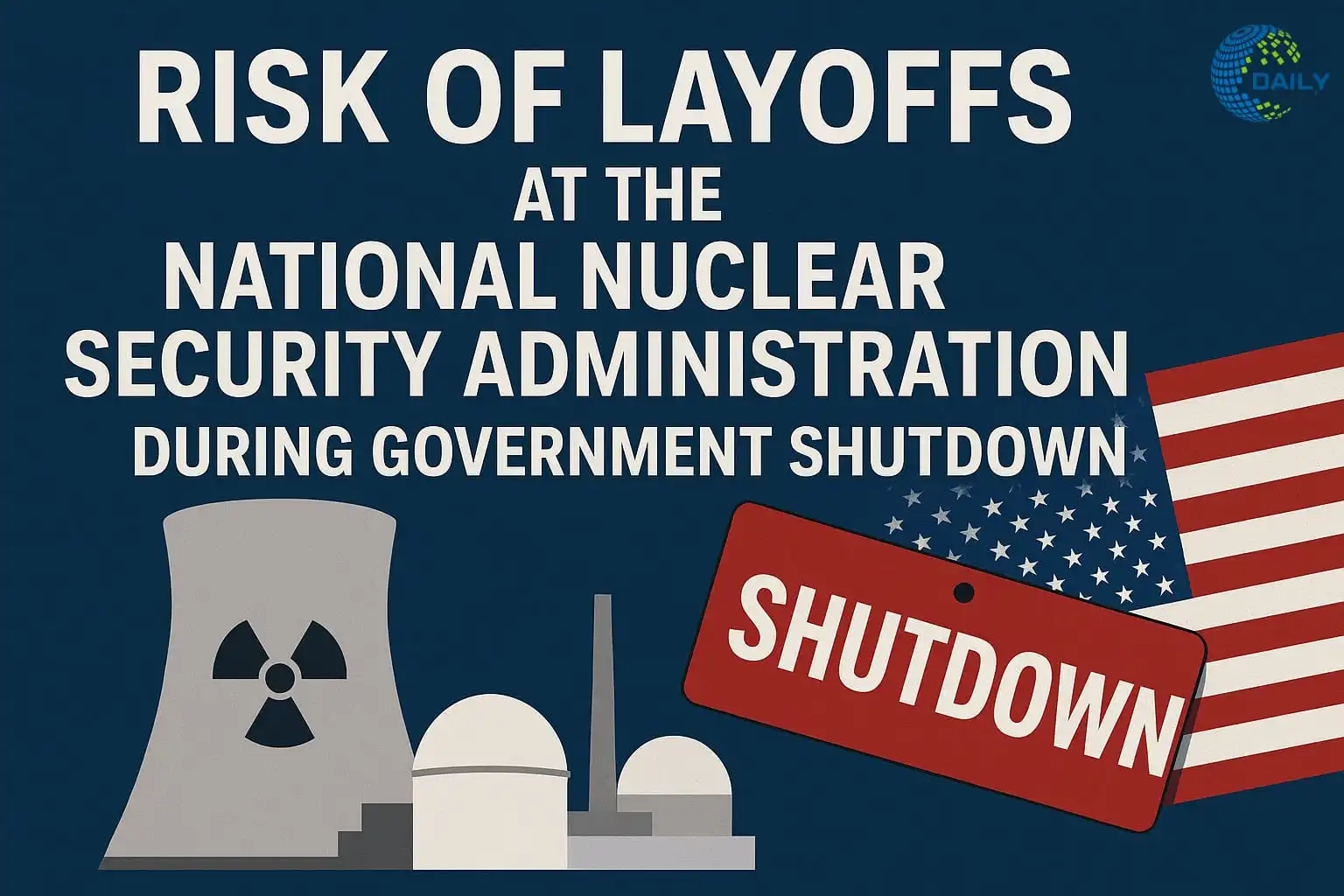
The United States, one of the world’s greatest powers, is facing an unprecedented situation today. The government shutdown has now deepened the crisis of layoffs at the US National Nuclear Security Agency.
This is the agency responsible for the security, maintenance, and modernization of America’s nuclear weapons stockpile. But when the decision was made to temporarily furlough nearly 80% of its employees, the entire world became concerned—is US nuclear security now at risk? Is this situation merely administrative, or is there a deeper political conflict behind it?
In this blog, we will explore in detail:
- the reasons for the shutdown,
- How important is the role of the NNSA?
- what the potential impact of layoffs will be,
- and what impact it could have on world peace.
➡️ What is a Government Shutdown?
A “shutdown” in the United States occurs when Congress fails to pass the necessary budget for a fiscal year. This deprives government departments of their spending authority and forces them to temporarily halt their activities.
✅Why did this happen?
The 2025 budget resulted in sharp disagreements between the Republican and Democratic parties over defense spending, immigration policies, and tax reform. The result—the dispute, which began on September 14th, has now reached its 18th day, with no resolution in sight.
✅Which departments are affected?
- The Department of Education,
- Healthcare,
- National Parks,
- And now the Nuclear Security Agency (NNSA)—all are affected.
➡️ What is the NNSA, and what does it do?
✅ Introduction to the Agency
The National Nuclear Security Administration is an independent unit of the U.S. Department of Energy, established in 2000.
✅ Main Functions
⏺️Securing the US nuclear weapons stockpile.
⏺️Modernizing and maintaining weapons.
⏺️Scientific research and testing to keep the nuclear system up to date.
⏺️Preventing international nuclear proliferation.
⏺️Promoting the peaceful use of nuclear energy.
✅ Why is the NNSA important?
This agency is a pillar of security not only for the US but for the entire world. The US possesses over 5,200 nuclear weapons, and their maintenance tolerates no lapses.
➡️ Layoff announcement—a dangerous turning point
Due to the shutdown, the NNSA has had to furlough 80% of its employees. This means these employees are on temporary leave and will not receive pay.
✅ Affected areas include
- Nuclear stockpile maintenance centers
- Weapons testing laboratories
- Security control units
- Los Alamos and Sandia National Labs
✅ Agency statement
Due to the current budget situation, we are forced to furlough most of our personnel temporarily. This will impact our ongoing modernization programs.
✅What does this mean?
- New nuclear technology tests will be halted.
- Maintenance and safety inspections will be delayed.
- Cybersecurity and data monitoring will be slowed.
➡️ International Impact
US nuclear policy is linked to global security. Following this layoff, many countries—Russia, China, North Korea, and Iran—are closely monitoring the situation.
✅ Russia and China’s Reaction
Russian media have called this “US administrative weakness.” China has also called it a “threat to global stability.”
✅ NATO Concerns
NATO allies are concerned that delays in US security agencies will impact their shared defense strategy.
➡️ Expert Opinions
✅ Dr. Michael Hudson (Former NNSA Scientist)
This isn’t just an administrative problem. When so many scientists and engineers are idle, weaknesses in the security system are bound to arise.
✅ Prof. Lisa Roberts (Harvard University)
Maintenance of nuclear weapons requires constant monitoring. Even the slightest delay can create unexpected technical risks.
➡️ Not the first time in history
This is not the first time the NNSA has been affected. Previous shutdowns in 2013 and 2018 saw limited impact, but the 2025 situation is the most serious because:
- 80% of the agency’s personnel are furloughed,
- The budget dispute has entered its third week,
- International tensions are at an all-time high.
➡️ Technical Challenges
Nuclear programs are extremely sensitive and complex. The facilities operated by the NNSA require round-the-clock monitoring, temperature control, radiation protection, and data analysis.
✅Layoffs mean
- Gaps in data monitoring,
- Increased likelihood of hardware errors,
- and increased vulnerability to cyberattacks.
➡️ Economic and Political Aspects
✅ Economic Impact
The layoffs will stagnate scientific research, disrupting government investment and defense contracts. The US defense industry could suffer billions of dollars in losses.
✅ Political Impact
This situation raises questions about President Donald Trump’s administrative efficiency. The opposition alleges that
Trump’s political obstinacy has put US national security at risk.
➡️ Impact on the Global Security System
The US is a permanent member of the United Nations Security Council. Its nuclear policies shape the direction of global disarmament efforts. If the NNSA is inactive, other countries could accelerate their weapons programs.
This could upset the “balance of security.”
➡️ Reactions from ordinary Americans
“#NoKings” and “#EndTheShutdown” are trending on social media. People are questioning—“Is our national security at stake amid the government’s infighting?”
Many former military personnel also expressed their concerns.
We are proud to be a nuclear power, but today our power has become a political prisoner.
➡️ What will happen next?
Whether the US Congress finds a solution soon will be determined in the coming days.
If the shutdown continues into next week, the NNSA’s reactors, labs, and security stations could remain closed for an extended period.
Ultimately, an agreement between the President and Congress is the only solution.
➡️ Conclusion
Nuclear weapons are not just a symbol of power, but also a symbol of responsibility and discipline.
The layoffs at America’s nuclear security agency are demonstrating to the world that political instability can shake the foundations of any superpower.
If a solution is not found soon, this crisis will not only be America’s but will become a warning to the safety of all humanity.