
 dailyupdate4u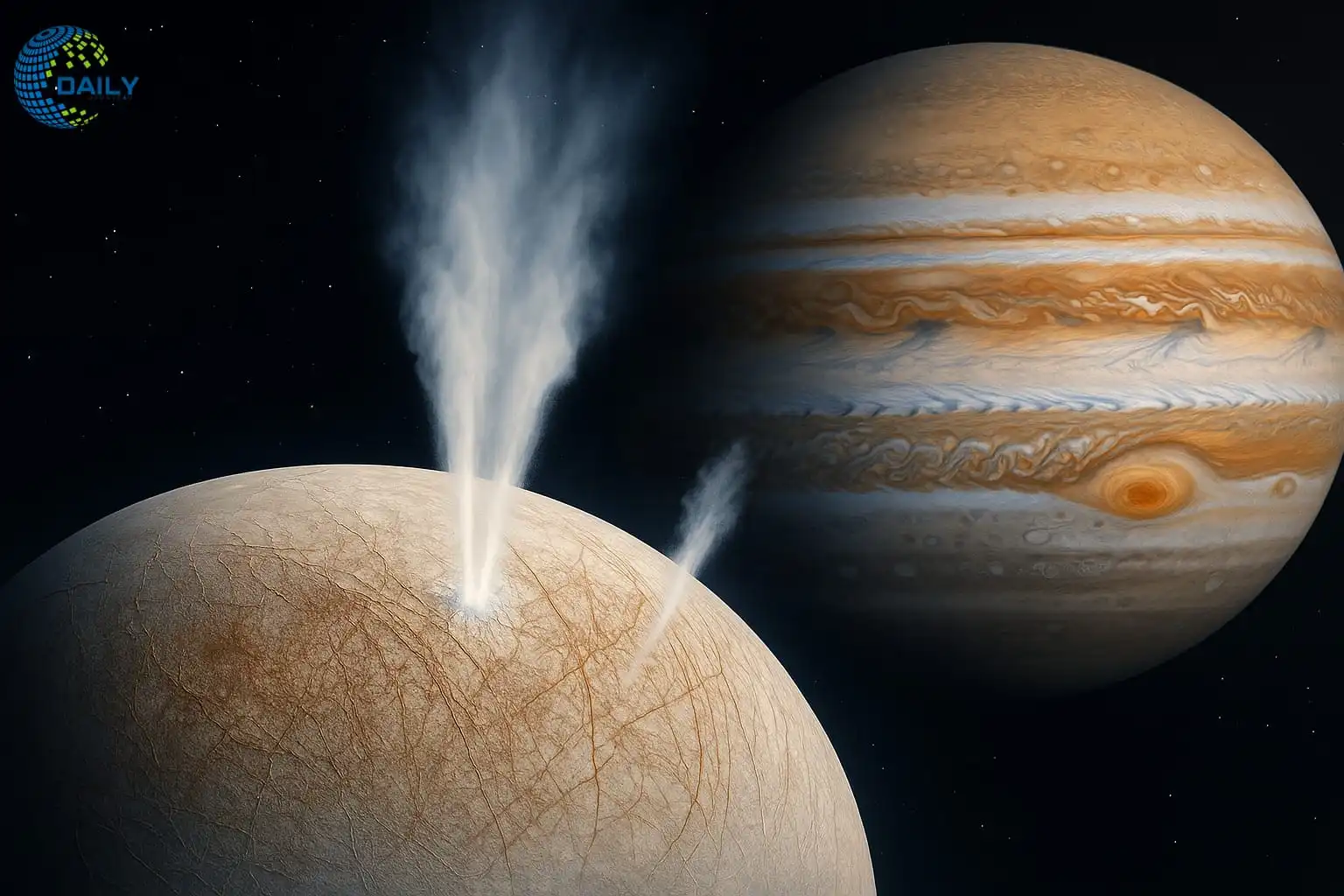
Space has always been a mysterious area of human curiosity. Ever since humans have looked up at the sky, one question has lingered—are we alone in this universe?
The US space agency NASA has taken a major step toward finding the answer to this question. Recently, NASA confirmed the presence of water on Jupiter’s moon Europa. This discovery is extremely important from a scientific perspective because where water exists, the possibility of life also increases.
➡️ Background to NASA’s Discovery
NASA has been studying Jupiter and its moons for the past several decades.
The Galileo mission, launched in the 1990s, first sent detailed images of Europa’s surface. These images revealed thick layers of ice, leading scientists to believe that an ocean of water might exist beneath it.
A new NASA analysis in 2025 further strengthened this possibility.
Data from the James Webb Space Telescope and the Hubble Telescope showed that fountains of water vapor are erupting from Europa’s surface, indicating that liquid water exists beneath its ice crust.
➡️ Europa’s Geological Structure
Europa is one of Jupiter’s more than 95 moons, but its size and characteristics set it apart.
Diameter: About 3,100 kilometers (slightly smaller than Earth’s Moon)
Surface: Covered in ice, marked by cracks and lines
Internal Heat: Jupiter’s gravity generates heat in its interior
Temperature: Less than -160°C, but temperatures are higher in the inner layer
Signs of activity, such as volcanic activity, have been found on Europa’s surface, suggesting the existence of energy sources within. Water and energy, two of the most important elements of life, make the existence of life on Europa a possibility.
➡️ How were signs of water found?
NASA used several techniques to find signs of water:
✅ Spectroscopy – This technique analyzes light reflected from the surface. This revealed to scientists that a layer of liquid water may exist beneath the ice.
✅ Infrared data – Water vapor molecules were clearly visible in infrared signals obtained from JWST.
✅ Magnetic data – Fluctuations in the magnetic field around Europa were detected, indicating that there is a saltwater ocean there that is generating electrical currents.
➡️ Why is this discovery significant?
This discovery has several scientific and philosophical implications—
✅ Possibility of life – If there is water, there is also the possibility of microbial life.
✅ Evidence of life outside Earth – If signs of life are found there in the future, it would be the biggest discovery in human history.
✅ The direction of space missions will change – future missions will now focus on Europa, not just Mars.
➡️ NASA’s “Europa Clipper Mission”
NASA has already prepared a mission to explore this discovery in greater depth – the Europa Clipper Mission. This mission is expected to launch in late 2025 or early 2026.
✅ Its objectives will be:
Studying Europa’s surface and atmosphere
Exploring the depths of the ocean beneath the ice
Searching for the chemical elements necessary for life
This mission will orbit Jupiter and fly by Europa dozens of times to gather detailed data.
➡️ Is life possible on Europa?
The temperature on Europa is very low, but its atmosphere and internal heat could make life possible.
On Earth, microorganisms are found that survive in extremely harsh conditions, such as:
Under the deep ocean
In volcanic lava
In the ice of Antarctica
If such organisms can live on Earth, then there could be microorganisms in the waters of Europa as well.
➡️ Scientists’ Reactions
NASA scientist Dr. Laura Benson said,
“Europa is the most likely place in our solar system where life outside Earth could be found.”
The European Space Agency is also working in this direction through the “JUICE Mission.”
This discovery has sparked excitement in the international scientific community.
➡️ Future Plans
NASA plans to send a lander mission after Europa Clipper, which could melt the ice and send instruments into the ocean below.
If signs of life are found there, it will be a new chapter not only for science but also for human civilization.
➡️ India’s Role in Space Research
India’s space agency, ISRO, has also welcomed this discovery.
India may collaborate on research on outer planets in the coming years, following the completion of projects like “Shukrayaan” and “Gaganyaan.”
The “NISAR” mission between NASA and ISRO is already underway, and a “Europa Study Collaboration” is also possible in the future.
➡️ Religious and Philosophical Perspectives
This discovery isn’t limited to science.
This question has been troubling human civilization for centuries: “Did God create life only on Earth?”
If life is found on Europa, it will also reshape our religious and philosophical views.
➡️ Public Reaction
People on social media are calling this discovery “the most exciting news in human history.”
Hashtags like “#EuropaLife” and “#NASADiscovery” are trending on Twitter (X), Reddit, and YouTube.
➡️ Next Steps in Space
NASA is now working in three directions:
✅ Europa Clipper Mission (2025-26)
✅ To build a base on the Moon
✅ To bring soil from Mars
After all this, humanity’s goal will be to reach the Jupiter system and find evidence of life.
➡️Conclusion
This NASA discovery could become one of the most exciting chapters in human history.
The presence of water on Europa proves that the universe is alive and dynamic.
When a future spacecraft goes there and finds evidence of life, it will prove that Earth is not alone.