 dailyupdate4u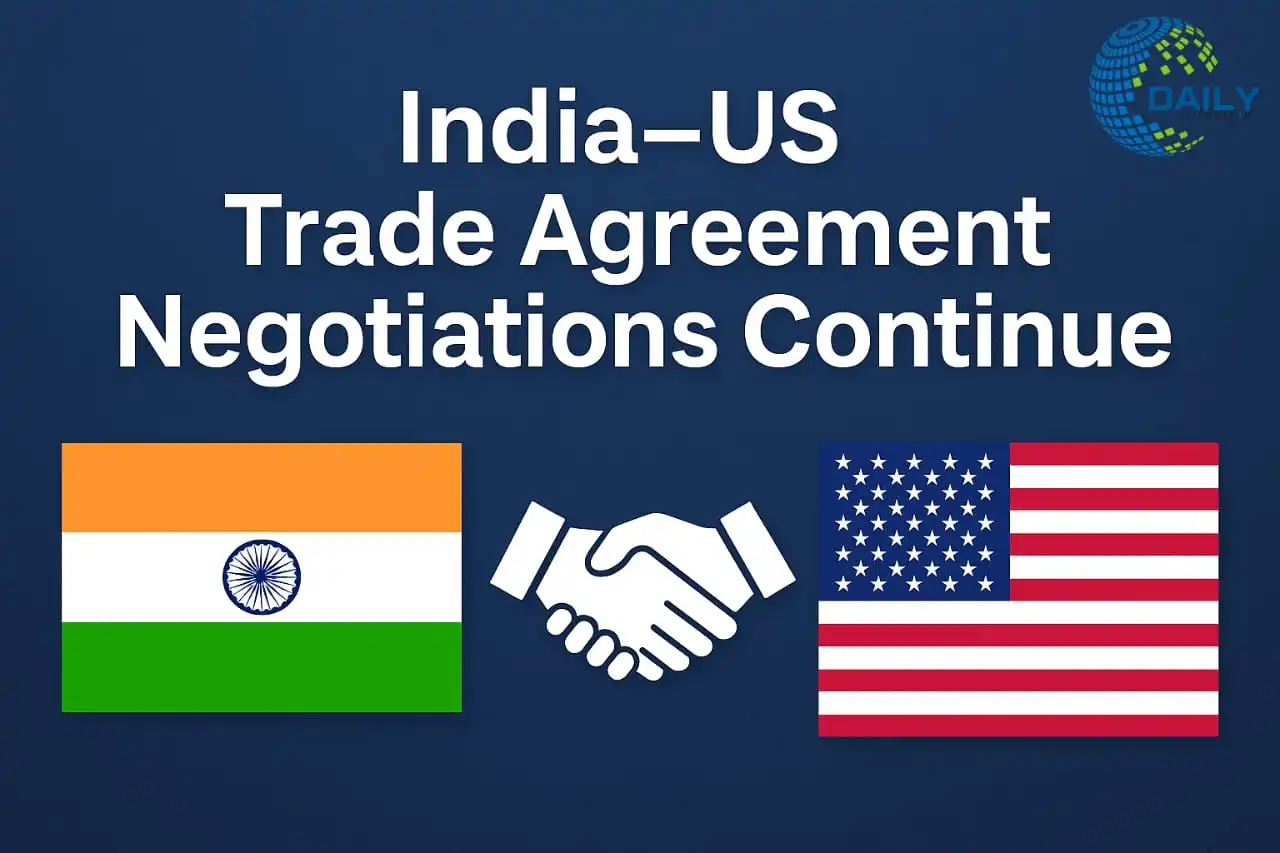
India and the United States are the world’s two largest democratic powers. Economic, strategic, and technological cooperation between the two countries is steadily growing. Trade relations have experienced many ups and downs over the past few years, but both countries are now moving toward a comprehensive trade agreement that could shape the course of global trade for decades to come.
These negotiations between India and the United States have intensified again. Despite the US government shutdown and global economic uncertainties, both countries have made it clear that they are working toward finalizing the agreement by November 2025.
This blog will explain in detail what this agreement is, why it is important, the issues being discussed, and how it will impact the economies of both India and the United States.
➡ History of India-US Trade Relations
Trade relations between India and the United States go back several decades. When India adopted a socialist model after independence, trade with the United States was limited. But after the economic liberalization of 1991, India opened its doors to global trade.
Since then, India-US trade has grown steadily.
Trade between the two countries was approximately $20 billion in 2000.
By 2024, it was projected to exceed $200 billion.
The United States is India’s largest trading partner, while India is among the top 10 trading partners.
India primarily exports pharmaceuticals, IT services, textiles, steel, and auto parts to the United States. The United States exports machinery, defense equipment, high-tech products, and agricultural commodities to India.
➡ Why is a trade agreement needed?
Although trade is steadily growing, numerous tariffs, regulatory hurdles, and policy differences are limiting this relationship.
Both India and the United States want a formal trade agreement to facilitate trade.
The main objectives of this agreement are:
✅ Reducing or eliminating tariffs.
✅ Promoting investment.
✅ Cooperation in the services sector.
✅ Cooperation in agriculture and manufacturing.
✅ Digital trade and intellectual property protection.
✅ Establishing a permanent mechanism for resolving mutual disputes.
➡ Current Negotiation Status (to 2025)
Trade talks between the two countries have intensified again in 2025. Several rounds of meetings have taken place between Indian Commerce Minister Piyush Goyal and US Trade Representative Katherine Tai.
Recently, both Washington and New Delhi have indicated that a “preliminary draft” of the agreement could be ready by November 2025.
The two countries are trying to agree on points within the “Bilateral Trade Agreement” that will not harm any sector.
➡ Key Issues Under Negotiation
✅ Tariff and Duty Structure
The United States wants India to reduce high import duties on several American products—such as agricultural goods, dairy, and electronic goods.
India argues that this will harm its small traders and farmers.
✅ Pharmaceutical and Medical Device Sector
India wants greater access for its pharmaceuticals and generic medicines in the American market.
The United States is demanding stricter patent protection.
✅ IT and Services Sector
India is seeking the easing of H-1B visa policies in the United States to facilitate the employment of Indian professionals.
The United States wants India to make its digital data laws transparent.
✅ Agriculture Sector
India wants to ensure that the influx of American agricultural products does not impact India’s small farmers.
The United States wants India to ease restrictions on GMO (Genetically Modified Organisms) products.
✅ E-commerce and Data Security
India’s e-commerce market is huge for American companies like Amazon and Walmart (Flipkart).
India maintains strict laws on local data storage and consumer privacy.
The United States wants these regulations to be relaxed.
✅ Defense and Aerospace Cooperation
Both countries want to deepen defense cooperation. The United States wants India to increase its purchases of defense products, while India also wants to ensure technology transfer.
➡ Economic Impact
Benefits for India
✅ Increased foreign investment.
✅ US cooperation in high-tech sectors.
✅ Support for the agricultural and manufacturing sectors with modern technology.
✅ Stabilization of the IT and services sectors.
➡Benefits for the United States
✅ Deeper access to the Indian market.
✅ Cost reductions through partnerships with “Made in India.”
✅ India’s emergence as an alternative to China in Asia.
➡ Challenges
✅ Policy differences: India’s “Atmanirbhar Bharat” policy and the United States’ “America First” policy often clash.
✅ Tariff disputes: The United States previously excluded India from the GSP (Generalized System of Preferences) list, causing harm to Indian exporters.
✅Political pressure: The internal political climate of both countries also influences negotiations.
✅Data and privacy laws: This is the most complex issue, with the US seeking “free flow of data” and India insisting on “data localization.”
➡ Expert opinion
Economists believe that this agreement could be extremely beneficial for both India and the US.
According to Dr. Arvind Subramanian (former Chief Economic Advisor), “If this agreement is successful, India’s exports could increase by 30% over the next five years.”
American trade analyst Michael Clarke says, “India could become the best strategic alternative to China for the US in Asia. This agreement will connect both countries technologically and economically.”
➡ New possibilities in the digital age
Trade is no longer limited to goods and has expanded to digital platforms, artificial intelligence, cybersecurity, and data infrastructure.
The partnership between India’s “Digital India” and America’s “Silicon Valley Innovation” could give the world a new direction.
Establishment of joint AI research centers.
Collaboration in 5G and 6G network development.
Joint projects in quantum computing.
➡ The Way Forward
If this trade agreement is reached by November 2025, it will take the economic relationship between the two countries to the next level.
It could make India a hub for global supply chains in Asia, while providing the United States with a stable and democratic partner.
This will also have a positive impact on the global economy, since India and the United States together account for approximately 25% of global GDP.
➡ Conclusion
The India-US trade agreement is not just an economic deal between two countries, but a symbol of a strategic partnership.
While India is moving towards self-reliance and technological advancement, the United States wants to maintain global leadership.
The partnership between the two will not be limited to trade, but will also open up new possibilities in areas such as science, technology, defense, education, and climate change.
If successful, this agreement will be one of the most significant economic developments of the 21st century—one that could benefit not only India and the United States, but the entire world.