 dailyupdate4u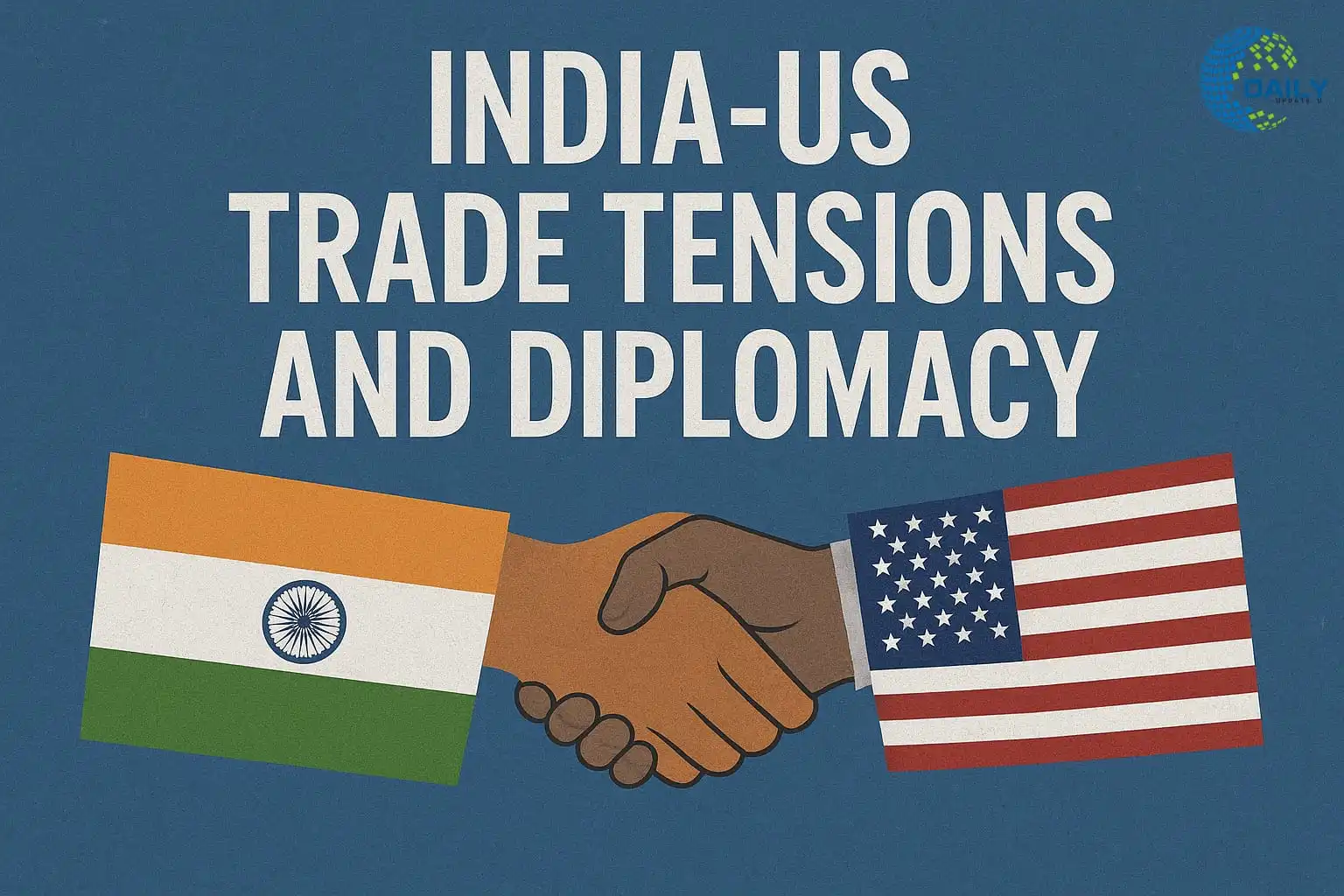
India and the United States, two of the world’s largest democratic powers, have become strategically, economically, and politically crucial partners over the past three decades. Despite this deep partnership, trade disagreements, tariff disputes, and diplomatic tensions have frequently plagued the two countries.
Even in 2025, the India-US relationship continues to experience many ups and downs. While both countries are leading a strong Indo-Pacific alliance, differences are emerging on issues such as tariffs, technology access, agricultural exports, defense agreements, and data protection.
In this blog, we will explore in detail the roots of India-US trade tensions, the reasons for their escalation, the steps taken, and the likely future direction of these relations.
➡️History of India-US Trade Relations
Trade relations between India and the United States grew rapidly after the 1990s.
Following India’s economic liberalization in 1991, the United States became a major investor in the Indian market.
Cooperation in the IT, pharmaceutical, and defense sectors grew rapidly in the 2000s.
After 2010, India became a major trading partner for the United States.
✅ Currently, the total value of India-US trade exceeds approximately $190 billion.
The United States is India’s largest export market and second-largest investor.
But along with the success of this partnership, many complex issues have also emerged, such as tariffs, patent laws, restrictions on agricultural products, e-commerce regulations, and data security policies.
➡️How did the India-US trade tensions begin?
The foundation for trade tensions was laid when the United States adopted an “America First” policy.
In 2018-19, President Donald Trump increased tariffs on several countries, including India, stating that “India makes American products more expensive and harms American companies.”
✅Key Events
In 2018, the US imposed 25% and 10% tariffs on steel and aluminum imports from India.
In 2019, India was excluded from the Generalized System of Preferences, ending tax exemptions for over 2,000 Indian products.
✅India’s Response: India also imposed retaliatory tariffs on US agricultural products, including almonds, walnuts, and apples.
This period brought the biggest trade tensions in India-US relations.
➡️ India-US 2020-2024 Trade Improves, but Mistrust Remains |
Later, the atmosphere improved somewhat during President Biden’s tenure.
He stated that India-US relations are not just trade, but a “Global Strategic Partnership.”
✅Nevertheless, some old disputes persisted.
The US wanted India to further ease foreign investment rules in the agriculture and e-commerce sectors.
India wanted the US to ease restrictions on H-1B visas, technology transfers, and pharmaceutical exports.
Although the two countries held several rounds of talks under the Indo-US Trade Policy Forum, no major free trade agreement was reached until 2025.
➡️ New Trade Crisis of 2025 for India and the US
Tensions between the two countries escalated once again in 2025 when the US imposed a 25% tariff, impacting India’s exports of trucks, steel, and tech products.
The US argued that Indian companies were adopting “unfair trade practices.”
India strongly criticized this move and filed a complaint with the WTO.
India argued that these US tariffs amounted to “protectionism” and harmed global trade.
✅This decision affected trade worth $12 billion between the two countries.
➡️Major Contentious Issues Between India and the US
✅ Tariffs and Duties
The US wants India to reduce its import and export duties,
while India maintains that developing countries have the right to protect their domestic industries.
✅ IT and Data Security
India has implemented data localization laws, requiring companies to store Indian citizens’ data in India.
American tech companies like Google, Amazon, and Meta have objected to this rule.
✅ Agriculture and Food Products
India bans American GM crops, while the US calls it an “unscientific obstacle.”
✅ Drug and Patent Laws
The US has repeatedly questioned India’s generic drugs.
The US wants India to amend its “intellectual property rights” regulations, while India emphasizes the availability of affordable medicines.
➡️ The Role of Indian and US Diplomacy
Diplomacy has played a crucial role in maintaining dialogue between the two countries.
The Foreign Ministers, Trade Ministers, and National Security Advisors of India and the US have been in regular dialogue.
✅Key Diplomatic Forums
Quad Alliance (India, US, Japan, Australia) — Security and economic cooperation in the Indo-Pacific region.
Indo-US Strategic Energy Partnership — Joint investments in the energy sector.
Initiative on Critical and Emerging Technologies — Cooperation in artificial intelligence, quantum, and semiconductor technology.
These forums have reduced tensions to some extent. But economic differences remain.
➡️ Will the two countries move towards a “Free Trade Agreement”?
There is no formal “Free Trade Agreement” between India and the US yet.
However, the two countries have agreed on a “Mini Trade Deal” in 2025, which includes
reducing tariffs on certain agricultural products,
concessions for medical device exports,
and increasing visa facilitation for the IT services sector.
If this deal is successful, a larger Comprehensive Economic Partnership Agreement between India and the United States could be possible by 2026.
➡️ Economic Impact of India-US Trade Tensions
✅Impact on India
The truck, steel, and automobile industries are affected by declining exports.
Temporary decline in US investment.
Funding in the startup sector slowed.
✅Impact on the United States
Prices of Indian pharmaceutical and IT services increased.
Inflation is impacted by rising consumer product costs.
Nevertheless, investors in both countries agree that
“India-US relations are too important to fail.”
➡️Strengthening India-US People-to-People Relationship
Even though there are differences between governments, the people-to-people relationship is strong.
More than 4.5 million people of Indian origin live in the United States.
Indian companies provide more than 200,000 jobs in the United States.
One in three tech engineers in the United States is of Indian origin.
This people-to-people relationship serves as a “soft power bridge” for both countries.
➡️Future Direction of India and the United States
✅Possibilities
Cooperation could increase in green energy, defense manufacturing, semiconductor technology, and space research.
India and the United States could work together to balance China’s economic policies.
Partnership will grow in the digital economy and cybersecurity.
✅Challenges
Protectionism
Impact of the Global Recession and Oil Prices
Political Shifts (US Elections 2026)
➡️Conclusion
India-US trade relations are not just economic, but a symbol of strategic and political partnership.
Even though differences may arise from time to time on issues such as tariffs, patents, data, and agriculture,
Both countries understand that global balance is incomplete without the other.
In the coming years, India-US relations can move from partnership to shared leadership.
This means that in the future, the two will jointly set new global economic standards not only in trade but also in technology, defense, and human resources.