 dailyupdate4u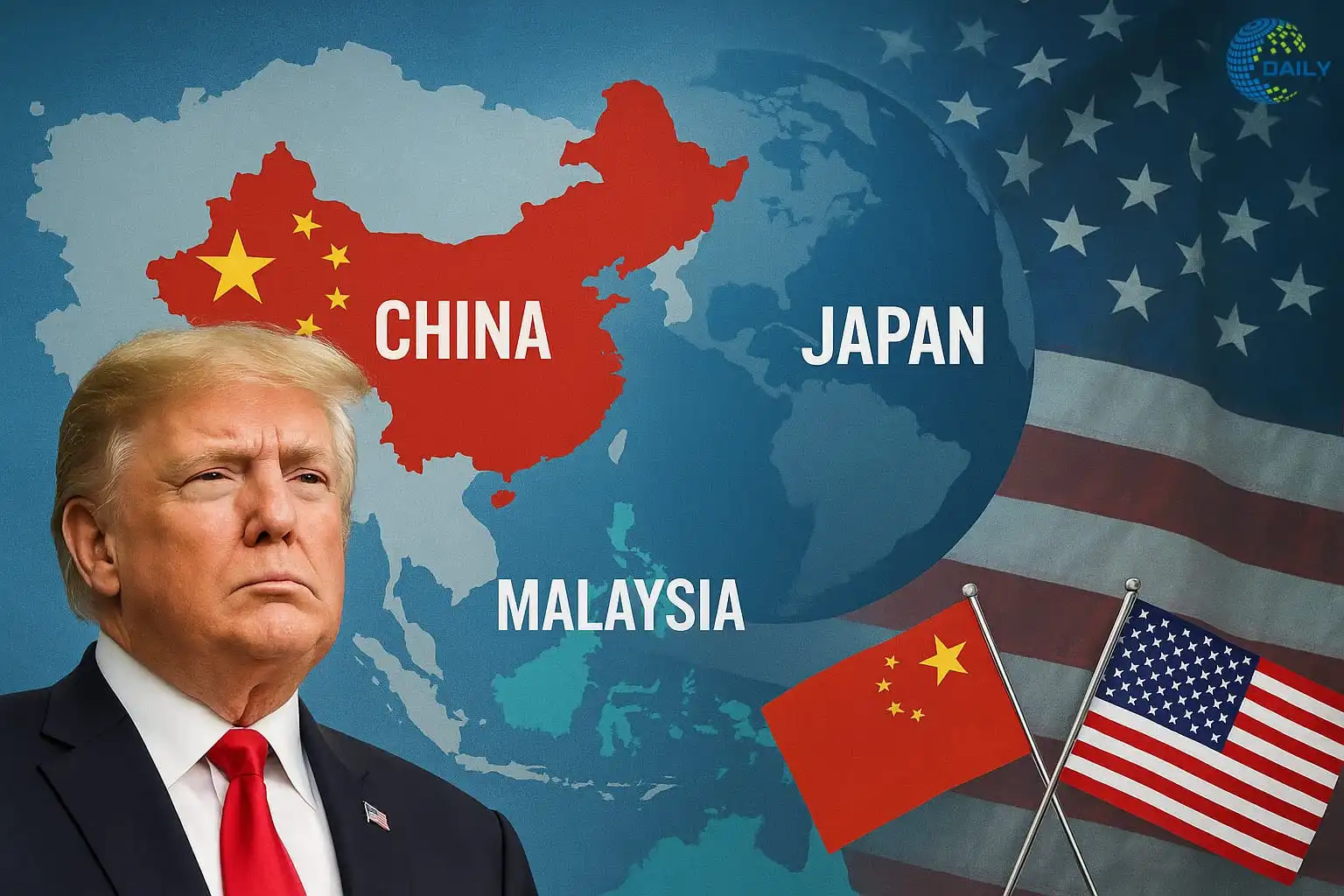
Global politics in 2025 are at a turning point where tensions between the United States and China have escalated beyond just economic ones, but also to strategic, technological, and ideological levels.
US President Donald Trump’s recent visit to Asia is considered extremely important against this backdrop.
This visit will not only redefine relations with Asian countries but also determine the direction of China-US relations.
Trump’s foreign policy has always been based on the principle of “America First.”
He believes that the United States should remain supreme in every field—whether trade, defense, or technology.
But Asia, especially China, has always been both a challenge and an opportunity for him.
➡️ Outline of the Asia Tour: Which Countries and Objectives
President Trump’s Asia tour primarily includes three countries—Japan, Malaysia, and possibly China.
✅ Japan
Japan has always been a reliable ally of the United States.
Trump will discuss security partnerships, technological investments, and defense cooperation with the Japanese Prime Minister.
He will also emphasize the need for a joint strategy with Japan to address China’s growing influence.
✅Malaysia
Malaysia is an important country in Southeast Asia that has become increasingly dependent on Chinese investment in recent years.
The Trump administration aims to bring Malaysia closer to greater trade and defense cooperation with the United States.
This move is a key part of the Indo-Pacific strategy.
✅China (Possible Meeting)
The most talked-about aspect of the trip is the potential meeting between Trump and Chinese President Xi Jinping.
The two leaders are likely to discuss tariffs, the trade deficit, semiconductor supplies, and rare earth metals.
➡️ A New Chapter in the US-China Trade War
The US-China trade war, which began in 2018, has now escalated into a technological and strategic conflict.
The Trump administration recently imposed sanctions on several Chinese companies and increased tariffs on electronic and mineral imports from China.
✅ China’s Response
China has also retaliated by imposing new controls on the export of rare earth minerals.
These minerals are vital to the US defense and technology industries.
This could impact American companies like Apple, Tesla, and Intel.
✅ America’s Stance
Trump says
“If China doesn’t trade fairly, the US will protect its industries.”
The US is now working to increase domestic production and investment in Indo-Pacific countries to reduce its dependence on China.
➡️ Battle for Technological Dominance
The technology sector is the biggest front in this conflict.
Both countries are trying to outdo each other in areas like 5G, semiconductors, artificial intelligence, and cybersecurity.
The US has imposed various restrictions on companies like Huawei, TikTok, and ZTE.
China is accelerating its AI and quantum computing programs.
The Trump administration is encouraging American technology companies to set up production facilities in other Asian countries.
⏺️ This has become not just a trade battle but a battle for technological dominance.
➡️ Diplomacy and Strategic Competition
Trump’s Asia visit is not limited to an economic agenda.
He will also discuss regional security, freedom of navigation, and China’s aggressive policy in the South China Sea.
✅ Indo-Pacific Alliance
The “Quad” group of the United States, Japan, India, and Australia is already active in countering China’s expansionism.
Trump wants more Asian countries to join this alliance.
✅ Taiwan Issue
The Trump administration has reiterated its support for Taiwan.
They have stated that the United States is committed to protecting Taiwan’s security and sovereignty.
This statement could further unsettle China, which seeks to bring Taiwan under its control.
➡️ Economic Impact: Impact on Global Markets
The escalating tensions between the US and China are impacting global markets.
The dollar has seen increased volatility.
Asian stock markets have declined.
Crude oil and rare earth metal prices are rising.
Experts believe that if a concrete trade agreement is not reached between Trump and Xi Jinping,
The risk of a global economic recession could deepen.
➡️Media and Public Opinion: What the World is Saying
A large section of the American media is calling Trump’s visit a “risky but decisive step.”
Many analysts believe this visit is a test of Trump’s foreign policy.
Chinese media is dismissing it as a “political drama.”
They say the US is trying to suppress China, but it will not succeed.
➡️ Future Direction: Cooperation or Conflict?
The outcome of the Asia tour will determine in the coming months whether the US and China will move toward cooperation or remain on the path of conflict.
If Trump secures strong agreements with Japan and Malaysia,
American influence in Asia could increase again.
But if negotiations with China fail,
A new trade and strategic crisis could arise in the future.
➡️Conclusion
“Donald Trump’s Asia tour” is not merely a diplomatic trip.
It is a sign of the 21st-century balance of power.
Both the US and China are currently contenders for global leadership.
Asia has become the center of this competition.
Trump’s visit makes it clear that
America still seeks to shape global politics according to its interests.
But China’s economic power and strategic policies are challenging this goal.
The future remains to be seen whether this visit will build bridges of cooperation
or further elevate the walls of conflict.